




Search our document section below where you will find IKO Products Brochures, Technical Data Sheets, BIM files, BBA certification, TDS documents and Case Studies showing full details of IKO installations.
For DECLARATION OF PERFORMANCE DOCUMENTS please visit ikodop.eu.
Please contact us if you require any further assistance or product information.



| Filename | IKO Guidance Document - IKO Self-Adhesive Membranes July 19 .pdf |
| Filesize | 6.58 MB |
| Version | 1 |
| Date added | July 29, 2019 |
| Downloaded | 376 times |
| Category | Technical Briefing Documents |
This document is designed to raise awareness and provide guidance on the recommended installation and application methods of the IKO Systems S-A, H-A and T-F membranes.Further to previous correspondence from IKO regarding the recommended installation and application techniques of the IKO Systems S-A, H-A and T-F membranes, specifically;
- IKO Systems S-A Vapour Control Layer
- IKO Systems H-A Underlay
- IKO Systems H-A Detailing Underlay
- IKO Systems T-F Underlay
- IKO Systems T-F Detailing Underlay
- IKO Safestick Prevent Cap Sheet
- IKO Polimar Preparation Layer
We would like to provide further clarity and guidance on our recommended installation techniques of the IKO Systems S-A, H-A and T-F membranes; and where used in conjunction with IKO torch applied cap sheets. This is highlighted in the photographic summary within this communication.
Whilst we appreciate that every installing operative has their own methodology and variable levels of application techniques of the installation of a roofing membrane, we feel the need to highlight the main areas of concern regarding the incorrect methods of application and installation techniques being used with some installing operatives that are not deemed acceptable to IKO.
We’re not trying to tell contractors how they must install IKO Systems S-A, H-A and T-F membranes, but to highlight the incorrect use and application that could result in a potential defect arising from poor installation techniques being adopted. Be mindful that it is the IKO Approved Contractor, who is ultimately responsible for their installation of IKO materials throughout the term of the guarantee. To minimise exposure to both IKO and the IKO Approved Contractor, this guidance document highlights some of the points to all installing operatives, and contractors who employ them.
IKO Systems S-A, H-A and T-F membranes have been designed to be applied to minimise the risks that are associated with hot works such as gas torch applied application near to, or adjacent to combustible materials. The use of IKO Systems S-A, H-A and T-F membranes is designed to reduce such risk during the installation to components such as timber decks or upstands, where torching directly to, isn’t recommended.
As I’m sure you are all aware of the risks associated with any roof waterproofing installation, whether it’s drying the roof, or applying the waterproofing components themselves, designing out the risk must be undertaken to all roof installations, and as part of that the correct material selection is part of that process.
The term self-adhesive can be misinterpreted by some. The term self-adhesive relates to the bond and adhesion of the membrane to a substrate where it has been installed, in conjunction with specially formulated bonding primers that react with the self-adhesive coating of the membrane to create the adhesion to the substrate. It doesn’t however, relate to the effective waterproofing sealing of any side or end laps that will always require heat activation to facilitate a waterproof seal. The term self-adhesive in the market place can be, and has been misrepresented and perhaps further clarity should be sought from other membrane suppliers. The factor that due to the variable inclement
weather of the UK, which can be very seasonal and regional, the term self-adhesive sealing of bitumen laps does not exist within the UK at present.
As an IKO Approved Contractor most of you should all be aware of the NFRC Safe2Torch guidance document, of which most of you would have pledged to support through your company to which I’m sure all would agree that for the safe working practices this is a major initiative for all roofing contractors and manufacturers alike to drive through safe working design and installations for the benefit of waterproofing works.
We’ve seen the demise of the traditional pour and roll bitumen membrane application through the introduction of torch applied membranes, and now adhered and hot air welded membranes becoming more predominant within the UK. It is therefore paramount that all IKO Approved Contractors ensure their installers are competent in the use, and installation of the products they are installing.
IKO can offer a range of product inductions to ensure the installing operatives become familiar with the installation techniques of components used within all IKO roofing systems. This isn’t solely for installers of the IKO products, but also available for contracts managers, estimators and managers alike; who feel the need to have a better understanding of the use, and installation techniques associated with these products so all projects can be effectively managed.
IKO have been a forerunner in the development of SA, H-A and T-F membranes As well as other cold applied systems and as part of those developments we must consider changing techniques required to how such products are used and installed. As part of this, the development of the IKO Flat Roofing induction programmes, these offer the installer, as well as managers who run projects the opportunity to broaden
their awareness of how products not only should be installed, but all other aspects, such as storage, weather conditions, drying off roofs, application techniques as well as product limitations and application considerations. All of the IKO built up roofing courses have been independently approved by the NFRC. For further information on the product inductions programmes IKO offer, please email your enquiry to [email protected]
Included within this communication are some typical examples of bad practice being seen during the installation process of these membranes? It also provides some recommended guidance and considerations for the installing contractor that may assist the installation process.
Storage and Weather Conditions
As with all waterproofing components whether they are membranes, primers, adhesives and insulation, their storage is of paramount importance to make the installation process easier.
Key considerations will be storage of the IKO Systems S-A, H-A and T-F membranes that will make it easier to install where the weather conditions would otherwise restrict or limit the installation process.
All IKO Systems S-A, H-A and T-F membranes will be affected by poor storage where stored:
Cold Weather Storage
Do not store IKO Systems S-A, H-A and T-F membranes on a roof where the temperature will drop to 5°C or lower. This will inhibit the installation process, and may result in shrinkage and ruckling of the membrane once the temperature has risen.
Sun Traps
Do not store IKO Systems S-A, H-A and T-F membranes in sun traps, as this will activate the tack within the coating and therefore restrict the easy of removing the release film.
Drying a Roof Where Naked Flame is Prohibited
Drying a roof off is probably the most debated topic for all roofing disciplines, as the most effective way has always been seen as being using a gas torch. However as a result of the safe2Torch guidelines and more specifiers specifying flame free applications the use of a gas torch is becoming more prohibitive.
The Etorch manufactured by Imperial Thermal Engineering allow a method of drying up a roof without the need for naked flames. It also allows a method of installing IKO Systems S-A, H-A and T-F membranes at lower temperatures.
The powerful electric torch is designed to perform like a traditional gas torch. It can deliver heated dry air at speed with temperatures up to 650°C.
It’s cheaper to run than a gas torch, no requirement to store gas bottles on site, no naked flames involved. However it does require a 3 phase power supply. It is clean and environmentally friendly to use. A gas torch will typically use 75Kw of energy and the Etorch only 22Kw; there are no noxious emissions such as CO2 and CO. Consideration of the contractor would be the benefit of potential reduced insurance cover where the use of gas may have been restrictive.
The additional benefit of the Etorch is the suitability to improve bond and adhesion where applying IKO Systems S-A, H-A and T-F membranes where the weather conditions would normally inhibit and restrict installation of IKO Systems S-A, H-A and T-F membranes at lower temperatures.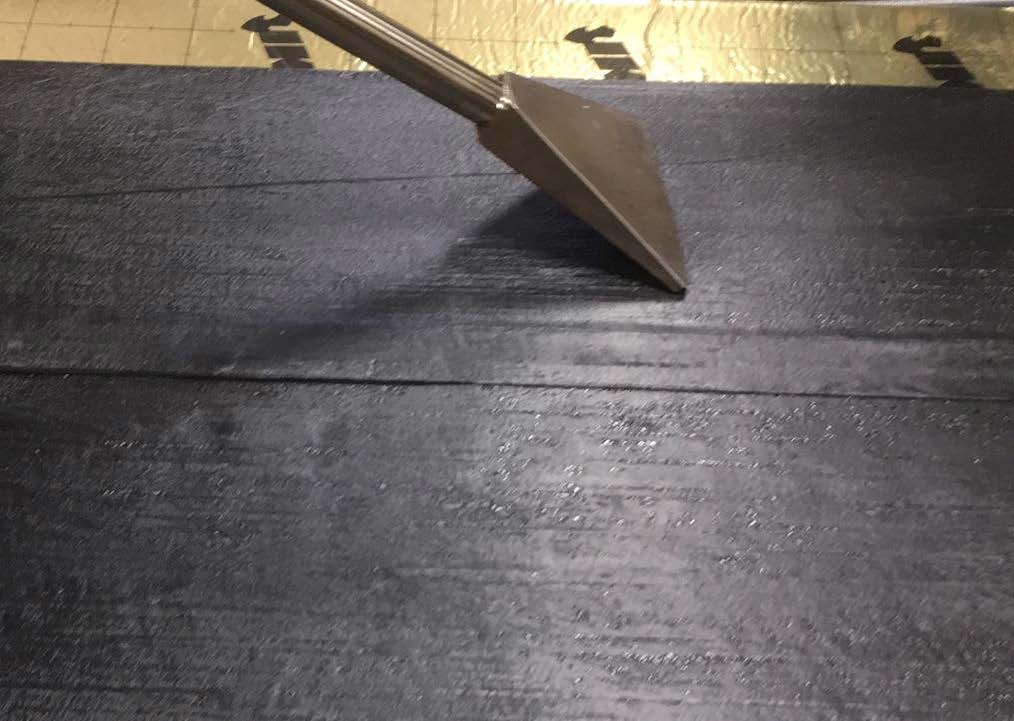
Running the Etorch over the surface of the IKO Systems S-A, H-A and T-F membranes will allow heat to be transferred through the membrane to assist with adhesion at lower temperatures.
IKO Systems S-A, H-A and T-F Membranes and Bonding Primers
All IKO Systems S-A, H-A and T-F membranes are required to be used in conjunction with either:
- IKOpro Sprayfast MPP
- IKOpro Systems Bonding Agent
These specially formulated primers react with the self-adhesive coating of the IKO Systems S-A, H-A and TF membrane to create a strong bond. IKOpro S-A bitumen primer could also be used, but doesn’t provide a bond as good as those recommended above, cure and grab time will also be slower.
All detailing works must be primed prior to the installation of any IKO Systems S-A, H-A and T-F membrane.
Torching of any IKO Systems S-A, H-A and T-F membrane through details is not recommended. Unprimed substrates will debond.
IKO Systems S-A, H-A and T-F Membranes and Release Film
IKO Systems S-A, H-A and T-F membranes all come with a sacrificial release film that must be removed during the installation process and disposed of. The removal of the release film should be by hand and the
release film bagged for disposal to prevent blowing across the roof.
Under no circumstances should the release film be attempted to be burnt off using a gas torch, this will result in lack of adhesion or non-effective sealing of the selvedge lap.
We would also recommend that the membrane is rolled into position and allowed to settle, prior to its application.
Over Torching and Scraping of the Laps
It should also be highlighted that any installation process does not require the membrane laps to be overheated and scraped. This compromises the integrity of the membrane, and is at greater risk of failing.
There are no standards that recommend this practice, and it goes back to the days of where pour and roll applications were common place. This application technique is down to bad practice and one of insecurity in the installation requirements. Installer competency should be assessed, and evaluated to determine if they are actually competent to install either IKO Systems S-A, H-A and T-F membranes or torch applied membranes.
Over torching an Air and Vapour Control Layer (AVCL) where the end lap has been overheated and scraped, resulting in exposure of the foil within the product is not recommended and a sacrificial layer should be applied over the affected areas.
Scraping Lap Joints
Scraping of the laps is merely a habit associated with the installation of pour and roll membranes. Again as stated above, the body of the membrane can be compromised should overheating occur. There is also an increased risk that overheating of the IKO Systems H-A Underlay over ALU insulation, may compromise the insulation facing by delamination of the ALU facing.
Blackening the underlay in such a manner greatly increases the risk of delamination and blistering occurring between the insulation facing and should be avoided.
Would You Install the Cap Sheet in such a Manner?
Roll bar/tube to install IKO Systems S-A, H-A and T-F Membranes
To assist with providing a uniform bond and adhesion to a substrate, it is recommended the use of a weighted roll bar to help with the installation of the IKO Systems S-A, H-A and T-F membranes, which assist and reduce the risk of non-adhesion being encountered during the application of the SA membrane.
Application, the membrane can be rollered to remove all entrapped air, and to provide a bond to the substrate.
Pressure Rollers
The use of a pressure roller will allow for an even bond to the substrate.
General practice is an operative using his hands to push out the roll, this can lead to air pockets being formed between the substrate and the IKO Systems SA, H-A and T-F Membrane, and then when the torch applied cap sheet is applied the risk of blistering can be increased.
The installer should ensure the application of all membranes is applied without air pockets being formed between each layer.
NOTE: As it has been stated previously within this correspondence, the bond and adhesion of the IKO Systems S-A, H-A and T-F membranes are not fully achieved until the torch applied cap sheet has been installed. So consideration on sequencing of the works is highly critical.
For example should the IKO H-A Underlay be installed, which is generally over the IKO enertherm ALU insulation, and then is left overnight. The full contact and adhesion hasn’t been achieved, and as such is vulnerable to wind uplift on the roof and weathering. This should be avoided by sequencing the works so as not to leave large areas not fully bonded to the roof which may result in blistering. In areas where restrictions apply, it would be recommended that such areas where the IKO H-A Underlay is being applied onto the IKO enertherm insulation and left over night, then the IKO enertherm ALU board facing should be primed with the IKOpro Sprayfast MPP or IKOpro systems Bonding Agent.
Sealing of Laps in IKO Systems S-A, H-A and T-F Membranes
If the torch applied cap sheet is applied over the IKO Systems H-A Underlay during the same working day, then there isn’t a requirement to seal side laps in the IKO Systems H-A Underlay.
All laps of the IKO Systems S-A, H-A and T-F Underlay are left exposed overnight; these will require sealing by hot air welding the lap joints to create a waterproof seal.
This may be achieved by hot air welding techniques using either hand hot air welders from BAKS, Sievert or Leister. With hand welding this will require typically a pre weld and a final weld to create the minimum 80mm lap joint required.
It is paramount this is achieved and a visible bead of bitumen exuded from all side and end laps.
For automatic welding machines for IKO S-A membranes, IKO only approve the BACS bitumen automatic welding machines to which will create an homogeneous 80mm lap weld. Other manufacturer’s auto welders tend to snarl up the membrane due to the size and as such are not recommended for IKO Systems S-A, H-A and T-F membranes.
The BAKS RE007 automatic welder for bitumen membranes as shown below will work on all IKO Systems S-A, H-A and T-F membranes. Approx. run speeds for the BAKS bitumen auto welder for IKO S-A membranes is approx. 3m/min. The BAKS RE007 automatic welder for bitumen membranes can also be used for IKO Mach One and UPXL T-F Cap sheets to create an 80mm single weld and will run at approx. 1.8m/min.
Installation of Torch Applied Cap Sheets
When installing a torch on cap sheet, it is important that the installing operatives are familiar with the techniques and installation methods required. The risks associated with naked flame are well known, and it is critical that the levels of competency of the installer are one who is competent to install torch applied membranes.
Torch Applied Cap Sheet
It is a requirement of IKO T-O membranes to create a full bond to the underlay. The bitumen flow should be consistent across the roll, being controlled to provide a consistent visible bead of bitumen exuded from all side
and end laps.
Where a lack of creating a full bond or consistent flow of bitumen across the torch applied cap sheet during the installation process, will result in air pockets being formed between the underlay and cap sheet. These will propergate and be visible during warmer weather conditions as the air trapped between the layers will expand, and form blisters within the roof finish.

It should be noted that it may not always be possible to identify this poor application upon initial installation, however will become evident on warmer days.
Roll Bars and Kick Rollers
The use of a roll bar or kick bar is recommended when installing all roofing membranes. For the IKO Systems H-A membranes a kick bar should be used and for torch applied membranes a roll bar.
These allow a more uniform controlled method of installation that will assist with removing trapped air, and provide sufficient pressure to provide an even flow of bitumen across the membrane.
Torch Applied Cap Sheet
All IKO torch applied cap sheets are to be fully bonded with sealed laps and a visible bead of bitumen exuded from all side and end laps. No air pockets should be formed during the installation process.
Use roll bar to provide even pressure throughout the width of the roll to assist with facilitating a consistent bead of bitumen from the lap joints.
There is no need or requirement where applying the torch applied cap sheet, to blacken the IKO Systems H-A membranes.
There seems a habit with some operatives to remove the granule facing of the IKO Systems H-A underlay by over torching during the installation of the cap sheet. This is not required. A consistent flow of bitumen created during the installation of the torch on cap sheet will provide sufficient bond and adhesion to the IKO Systems H-A Underlay.
Summary
The flat roofing industry has and is evolving to be more safety aware, the NFRC Safe2Torch guidance, the competency levels of the installers, and the manufacturers products performance and installation requirements to an array of different types of waterproofing membranes.
An IKO Approved Contractor, we would consider them to be the best in terms of their standards of workmanship. However, where subcontracted labour is appointed to install a roofing system, this at times can go astray. It is highly critical the selection of the installer is evaluated by their employer to ensure firstly, the installer fully understands not just the basic understanding of how to undertake and install a built up roofing system, but the application and installation requirement for each component used within the built up roofing system. Would you employ an operative who cannot provide this? How do you evaluate your subcontracted labour?
However, when it comes to IKO monitoring IKO projects that are not in compliance with the installation guidelines defined within the IKO specification document and product inductions; we obviously reserve the right to raise all concerns and issues regarding the incorrect installation to both their installers and their contracts managers for their actions. Again, as IKO do not demonstrate bad practice as part of their product inductions.
Hopefully the points highlighted within this communication have provided yourselves with some questions to ponder that should minimise risk of fires, as well as educating the installer of what should be considered as good practice for the installation of any built up roofing system. IKO are a leading manufacture who wishes to drive safe installations with long term performance through the Approved Contractors for the benefit of the whole roofing and waterproofing industry, we will continue to strive to undertake this through continuous development of its products and their methods of installations.
Disclaimer
Whilst every precaution is taken to ensure that the information given in this literature is correct and up to date it is not intended to form part of any contract or give rise to any collateral liability, which is hereby specifically excluded.
IKO reserve the right to amend and/or withdraw this document without notice.
Users of published guidance for the installation of IKO materials should therefore verify with the company whether any changes in our specification, application details, withdrawals or otherwise have taken place since this literature was issued.
 .
. .
.